In this week’s assignment for EDTECH 543, we were asked to make a creative expression to explain Connectivism, Personal Learning Networks, and Communities of Practice. For my creation, I chose to create a small-scale infographic that represents the flow of knowledge as I perceive it between these concepts.
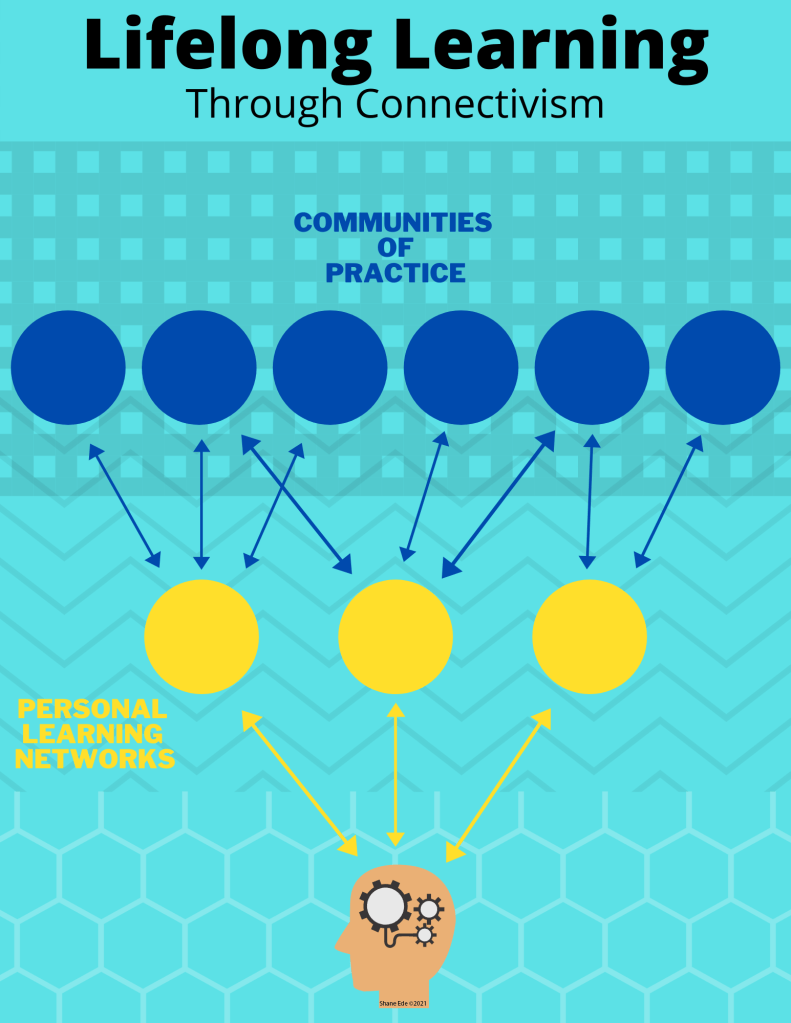
To me, Connectivism is a theory that attempts to explain how a person gains knowledge through connections and then creates new knowledge in return. We do this by creating personal learning networks. These networks are hyper-focused on something that we want to learn more about. If we want to learn more about social media, for instance, we might seek out a small group of experts on the subject to network with and learn more about the subject. Maybe our desire to learn more about social media is tied to our desire to become better teachers. While we might have some experts in our PLN who are non-teachers, there are likely to be a few who are teachers as well. They, along with us, belong to a much broader community of teachers who want to learn new things about teaching and share those things with other teachers. This larger group, I would consider a community of practice.
Claire Reinelt described the difference between PLNs and CoPs somewhat similarly, describing PLNs as more self-interest driven and CoPs as being more community focused. CoPs, by this definition are driven by a more global desire to contribute to the community and to make the overall practice better (2007). This collaborates the idea of connectivism as described by George Siemens where he states that connectivism starts with the individual and then expands in scope to a network and then further expands into institutions/organizations (or communities of practice). Another key point that Siemens makes is that the knowledge and learning move both inward to the individual and outward to the community (2017).
Using these definitions, Connectivism seems to make a great deal of logical sense. In my experience, we often gravitate towards those who have similar interests and form personal networks with those people. Perhaps we then also expand that network to include those who are outside our normal network and are in the community at large. I can easily find many examples in my own life that display what I would call connectivism as I was learning something new. Can you?
References:
Reinelt, C. (2007, September 9). Networks and Communities of Practice: What is the difference? Leadership Learning Community. http://leadershiplearning.org/blog/claire-reinelt/2007-09-09/networks-and-communities-practice-what-difference
Siemens, G. (2017). Connectivism. In Foundations of Learning and Instructional Design Technology. https://lidtfoundations.pressbooks.com/chapter/connectivism-a-learning-theory-for-the-digital-age/

 Shane Ede: My EDTECH Learning Log